
Meet the new Urban Matters, a digital community data platform powered by onebite RESEARCH
onebite’s urban data platform meets the world as an accessible tool to understand our neighbourhoods. Senior Researcher, Veera Fung, provides us with a holistic look into it.
Make it stand out
Whatever it is, the way you tell your story online can make all the difference.
onebite RESEARCH, the analytics arm of our studio, announces the launch of URBAN MATTERS—an accessible digital dashboard turning complex community data into actionable insights.
Rooted in our community architecture and research expertise, URBAN MATTERS provides strategic data analysis to bridge the gap between raw data and meaningful community action. We merge hard data with on-the-ground stories, and decode the performance of local neighbourhoods. Whether you are a local looking to understand your streets, a social service provider designing high-impact services, or a developer optimising site potential, this intuitive platform provides the empirical evidence you need to co-create a more resilient, empathetic, and inclusive community.
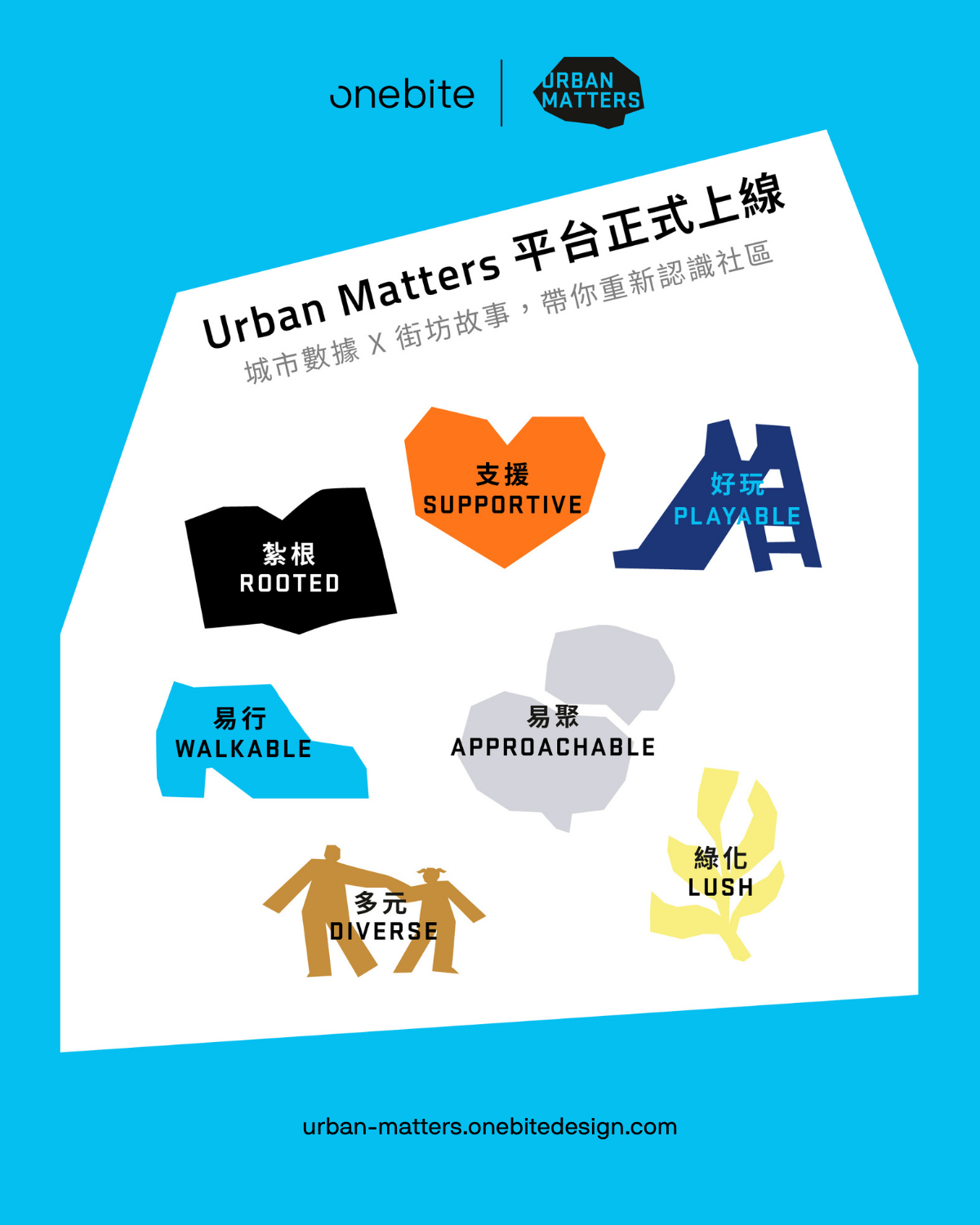
For the platform’s debut, URBAN MATTERS delves into what makes a neighbourhood inclusive. Our research team evaluates communities across seven attributes: approachability, diversity, lushness, playability, rootedness, supportiveness, and walkability. By mapping out both community strengths and service gaps, we deliver the insights needed to design truly loveable and inclusive environments.
The first set of data offers a fresh look at Kwun Tong. As our dataset expands, initial findings highlight Kwun Tong's solid healthcare foundation, featuring strong language support, active social enterprises, and widespread voucher use. However, spatial data reveals structural hurdles, such as steep terrain and limited after-hours care. We hope these insights guide future planning to gradually improve residents' everyday healthcare.
Veera Fung, our Senior Researcher heading the project, walks us through the platform and explains how it transforms invisible urban phenomena into insights to co-build an inclusive city.
Tell us about Urban Matters.
Veera Fung (VF): We recognise that there are many ways to look at a neighbourhood, and these varying perspectives lead to different understandings of our surroundings. We seek to use data as our way in—a lens to explore the underlying dynamics of our neighbourhoods. By merging this hard data with on-the-ground stories, we decode the performance of local areas into actionable insights.
How did OBR select the attributes?
VF: The research team has developed seven attributes— rooted, supportive, playable, walkable, approachable, diverse and lush— to evaluate the inclusivity of our neighbourhoods. These attributes were selected based on multiple established frameworks. Each is further divided into specific sub-dimensions, which are then measured using dedicated data points.
Interesting. Could you tell us a bit more about it?
VF: We begin with the smallest scoring component: the individual data point. After collecting and analysing the relevant data, we calculate scores for each sub-dimension. These are then consolidated to determine the score for each attribute, leading to an overall inclusivity score at both the sub-district and district levels.
How could this help drive impact in the community?
VF: It gives different stakeholders a clearer basis for deciding where action is needed and how it can be most effective. The findings can help social service providers set priorities, support the general public in understanding their neighbourhoods, and guide developers towards more responsive decisions.
More importantly, the platform creates a common starting point for conversation. By bringing evidence and lived experience together, Urban Matters can help turn local observations into focused interventions and encourage more meaningful collaboration across the community.
Explore Urban Matters here.
Veera Fung is a senior researcher holding a PhD in architecture from The Chinese University of Hong Kong. She actively works to bridge the gap between academic research and real-world application. Driven by a passion for community empowerment and social sustainability, Veera founded a design collaborative that explores how actionable research and design can foster inclusive cities.
